
Doorstep Pickup Is the New Status Symbol
July 27, 2026 · The Nadabox Team · 6 min read
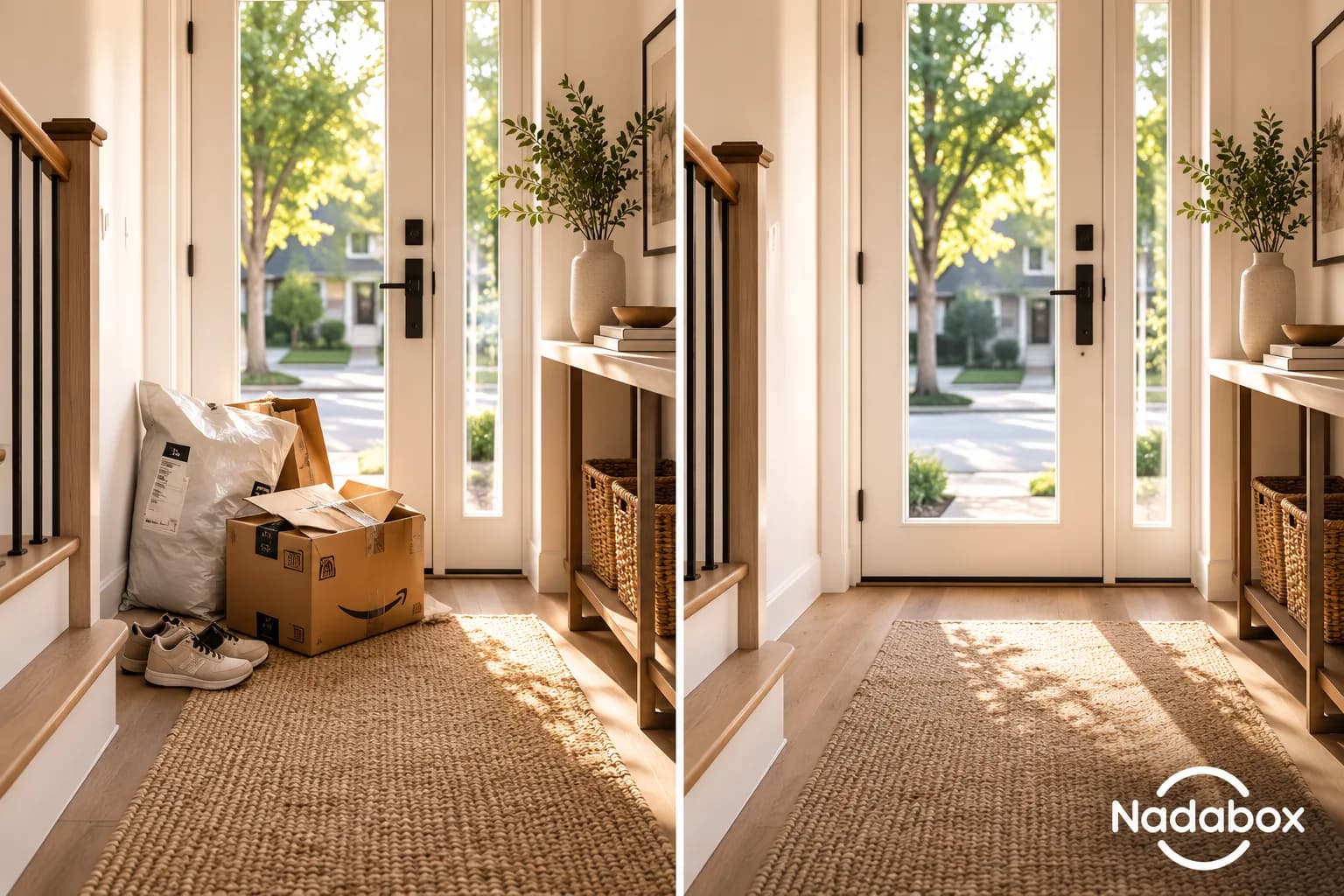
There's a bag by your front door right now. Or a box, half-taped, with a pair of jeans in it that didn't fit. It's been there a while. Long enough that you've stopped seeing it, and started seeing around it.
That bag is the most honest object in your house. It's not clutter, exactly. It's a task you've already paid for and haven't collected on — forty dollars sitting by the door, waiting for you to drive it somewhere.
There was a time when the flex was the delivery. The stack of packages on the porch said something: I shop, I have taste, I have a slightly concerning relationship with two-day shipping. But the vibe has shifted. Getting things fast is table stakes now — everyone can do it. The new status symbol is the thing going back without you thinking about it.
The old flex was arrival. The new flex is the return that already left.
Walk into anyone's entryway and you can read their whole life in the corner situation. The tote bag of returns that has achieved permanent residency. The shoebox with the label printed but never attached. The gadget that was somehow both too big and too small, still in its original packaging, still technically returnable for another four days.
The people whose homes look effortless don't have more willpower than you. They haven't got a special drawer for shipping tape. They've just removed the errand entirely. The return gets picked up from the doorstep. The refund lands. The corner stays clear.
Status in 2026 is not having a single item in your home that's secretly waiting on you to do something.
Why sending something back is so much harder than buying it
Let's name the asymmetry properly, because it's absurd once you see it.
Buying takes one thumb and four seconds. Undoing it takes: finding the order, requesting the return, waiting for the label, printing the label — on the printer, which is out of ink, obviously — taping the box, finding the box, and then driving the whole production to a drop-off point during hours that assume you don't have a job.
An entire industry spent twenty years engineering every second out of the purchase. Then the moment the box hit your porch, they handed the hard part back to you like a bill.
That's the gap. Not the shopping. The unshopping.
The refund you quietly decided not to collect
Here's the part that stings. Most unreturned items aren't a decision. They're a deadline you lost.
The return window doesn't care about your week. It closes while the bag sits there. And at some point you unconsciously reclassify the money — that forty dollars stops being yours and becomes the price of not making the trip. You didn't choose to keep the jeans. You just ran out of Saturdays.
Multiply that across a year of online shopping and it's real money, given away in small, forgettable increments, because the last mile of returning something was left entirely to you.
A return that gets picked up at your door isn't a convenience feature. It's the difference between money you meant to get back and money you didn't.
What doorstep return pickup actually looks like
The mechanics should be boring, and that's the point.
You tell us in the app that something's going back. You leave it by the door — in whatever it came in, no printer, no tape hunt, no box surgery. On your regular pickup day, it's gone. The return goes into the system it was always supposed to go into, and the refund does what refunds do.
No drop-off run. No line behind someone shipping a mattress. No return window quietly expiring while you mean to get to it.
That's it. The whole feature is an absence: the errand you never do.
The markers of the new put-together
Spend five minutes looking at how people talk about their homes now and you'll notice the aesthetic changed. It isn't maximalist. It's calm — clear surfaces, breathing room, no visual noise.
That look isn't achieved by shopping less. It's achieved by managing the churn. The new put-together looks like:
- No entryway graveyard. The spot by the door is for keys, not for returns aging like fine wine.
- Returns that just happen. No mental tab open for the thing you keep meaning to send back.
- Refunds you actually collect. Every return window closed on purpose, not by accident.
- A garage you can park in. Not one slowly being annexed by flattened cardboard.
None of these require you to buy differently. They just require the stuff going out to have somewhere to go, reliably, without you being the one to drive it there.
And yes, the boxes go too
While we're at your door for the return, the cardboard goes with us.
That's the other pile — the one that's a chore with no natural end. You break down a box, feel briefly accomplished, and three more arrive by Thursday. It's Sisyphus with packing tape you can never fully peel off. Recycling day comes every other week and holds roughly one-eighth of what you actually generate.
Doorstep pickup handles both halves of the same problem, because they were always the same problem: the physical aftermath of shopping, dumped on the person who just wanted a new lamp.
The part that isn't a flex — it just is
There's a reason to care beyond the clear corner.
A return that actually goes back gets resold or restocked instead of becoming somebody's disposal problem. Cardboard that actually gets collected stays in the loop and becomes boxes again. The pile-in-the-garage approach is where good intentions go to die — when the bin is full, the overflow ends up wherever's easiest.
Reliable pickup means the return gets returned and the recycling gets recycled. Rare that the flex and the right thing line up this cleanly.
Letting the errand go
Nobody wants to be the person with the shame bag by the door. We just haven't had a graceful way out of it. The return window doesn't care about your schedule, and the drop-off point isn't getting closer.
But the shift is happening. The people who seem to have it most together aren't working harder at their returns. They've decided the aftermath isn't theirs to manage — that shopping's convenience should last until the thing is gone, not end the second it arrives.
That's the whole idea behind Doorstep Unshipping™. The return goes back. The boxes disappear. The corner stays empty. The refund lands without you spending a Saturday on it.
Turns out the ultimate flex was never the delivery. It was never having to deal with what came after.
Ready to hand it off?
Join the club